تحضير دروس Learning Club للصف الاول لمادة اللغة الانجليزية الفصل الدراسي الاول المنهج العماني

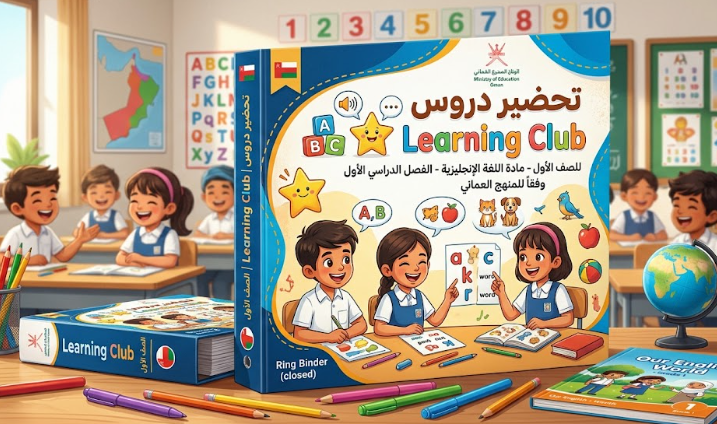
تحضير دروس Learning Club للصف الاول لمادة اللغة الانجليزية الفصل الدراسي الاول المنهج العماني
تحضير دروس Learning Club للصف الاول لمادة اللغة الانجليزية الفصل الدراسي الاول المنهج العماني قابلة للنسخ واللصق
English Language – Lesson Preparation – Team Together Oman – Cycle one
Lesson 1: Learning Club 1 – CLIL: Maths and Art
| Learning club 1- CLIL: Maths and Art | Team Together Oman 1 | 26-10-2023 | Thursday | Day/Date | |
| Activity Book Page: — | Class Book Pages: 28-29 | Get ready for … | 1 parts 1&2 | Lesson | |
| Grade 1 | Section | ||||
| 3 | Number of Aims/Learning Outcomes |
| Warm-up / Introduction – Starting the lesson (3 minutes) • Explain that in this lesson pupils will learn about colours and the numbers 1–6. |
| Vocabulary / Target language: red, yellow, blue, green, orange, brown; one, two, three, four, five, six |
| Teaching Materials / Resources | Implementation Approach / Activities | Teaching Strategies / Methods | Aims / Learning Outcomes |
| • Photocopiable 7 • Different coloured board marker pens (red, yellow, blue, green, orange, brown) • Number flashcards (1–6) • Colour flashcards (red, yellow, blue, green, orange, brown) • Colour Classroom Poster • Number Classroom Poster • Items for pupils to count (e.g. pens, crayons, etc.) • A model colour board and photographs of coloured items • Photographs pupils have brought to class for colour board | Class Book Pages: 28-29 Presentation (2 minutes) • Draw six coloured blobs on the board (blue, green, orange, red, yellow, brown). Point to each blob, say the colour and have pupils repeat after you. Do this several times. Say Point to ‘blue’. Pupils point and repeat the colour. Repeat this with the other colours. Practice Think: Can you count to six? (5 minutes) • Show pupils the Number Classroom Poster and focus on numbers 1–6. Elicit the words in English from pupils, if possible. Point to the numbers in order, say them and pupils repeat. Learn LC1.1 Listen, point and check. (5 minutes) • Focus pupils on page 28 of their Class Book. Ask pupils to point to the numbers. Then, ask them to point to the colours. Check: Look and say the colours. Count. (5 minutes) • Do the first item with the class. Look at the first picture. Say Red, yellow, green. Ask pupils to repeat. Say One, two, three! Three balloons. Pupils repeat. Use the Traffic light cards technique. Let’s practise! LC1.2 Look and say the missing numbers. Listen and check. (5 minutes) • Write numbers 1-6 on the board and ask pupils to say them. Then remove one number, and then two, and then three numbers from the sequence. Ask pupils to say the numbers including the missing ones. Look and say the colours (5 minutes) • Look at the pictures with the class. Pupils look at the items and work in pairs to identify the colours. Show what you know: Choose a colour. Make a colours board. (5 minutes) • Explain that pupils are going to make a colours board. Show them your example colours board. Ask pupils to identify what colour you have chosen. | Teaching Strategies: 1. Dialogue and Discussion 2. Survey 3. Brainstorming 4. Collaborative Learning 5. Predict, Interpret, Observe, Predict 6. Figure (7) Cognitive Standard 7. Story 8. Mind Maps 9. Inductive Discovery 10. Exploration 11. Learning by Doing 12. Role Play 13. Peer Learning 14. Problem Solving | By the end of this period, pupils are supposed to: • Introduce numbers and colours • Introduce number bonds Global Scale of English (GSE) Listening: Can use a few simple words to describe objects (e.g. colours, numbers), if supported by pictures (GSE 19). Speaking: Can say how many things there are (GSE 17). |
| Homework | Enrichment / Remedial Tasks / Differentiated Education | Formative Assessment / Summative Assessment |
| Finishing the lesson (5 minutes) • Say a number between 1 and 6 and elicit from pupils the number that comes after it. Extra activity: Photocopiable 7 • Use photocopiable 7 to review the vocabulary for the lesson. | Class reading – Unit 2 • Choose a story to read with the class. Follow the usual procedure of dealing with class reading (refer to the Introduction page 19). Quiz – Unit 2 • Pupils now complete the quiz for Unit 2. Give pupils support where necessary and focus time on areas where pupils commonly needed extra help. Praise pupils for their hard work and they will now move on to Learning club 1! | Assessment for Learning (formative assessment) Setting aims and criteria: Lesson objectives presentation Monitoring pupils’ learning: • Lollipop stick technique • Traffic light cards technique • Happy/sad face technique Peer learning: • Pairwork • Groupwork |
| Teacher’s Signature: ________________ | Supervisor’s Signature: ________________ |
📱 تابعنا على واتساب: اضغط هنا
Lesson 2: Learning Club 2 – CLIL: Maths (Shapes)
| Team Together Oman 1 | 26-12-2023 | Tuesday | Day/Date | ||
| Activity Book Page: — | Class Book Pages: 48-49 | Learning club – CLIL: Maths | 1 parts 1 and 2 | Lesson | |
| Theme: My favourite toy | Unit 4 | Grade 1 | Section | ||
| 3 | Number of Aims/Learning Outcomes |
| Warm-up / Introduction – Starting the lesson (3 minutes) • Draw the four shapes (square, circle, triangle, rectangle) on the board with different coloured markers. Point to each shape and say its name. Pupils repeat after you. Do this several times. Say What colour is the (square)? The (square) is (red). Point to the red square and have pupils repeat. Repeat with the different shapes. Pupils should respond with a complete sentence, e.g. The triangle is yellow. Repeat this with the other shapes. |
| Vocabulary / Target language: square, circle, triangle, rectangle |
| Teaching Materials / Resources | Implementation Approach / Activities | Teaching Strategies / Methods | Aims / Learning Outcomes |
| • Photocopiable 11 • Shapes Classroom Poster • Pictures of each shape on A4 paper • Pictures of common objects in shapes (pizza, slice of pizza, road sign, tennis ball, pyramid, traffic light, bike tyre, swimming pool, the Sun, book, tablet, etc.) • Different coloured markers • Cut-outs from magazines or newspapers of objects of one of the shapes • Poster paper, glue | Class Book pages: 48-49 Presentation (2 minutes) • Explain that in this lesson pupils will learn about shapes. Show pupils the sheets of paper with the shapes. Ask the class to call out each one as you show it. Practice Think: How many shapes do you know? (3 minutes) • Draw the four shapes on the board. Elicit the words in English from pupils, if possible. Chant them with the class (Circle! Square! Triangle! Rectangle!). In pairs, pupils say how many shapes they know. Learn LC2.1 Look and listen. Then listen and repeat. (2 minutes) • Focus pupils on page 48 of their Class Book. Ask pupils to point to the shapes. Play the first part of the audio for pupils to hear. Play the first part again, and ask pupils to point to the corresponding shapes. Then, play the second part, pausing after each shape, and asking the class to repeat the words. Check: Match the shapes from Activity 2 with the objects. (5 minutes) • Look at the pictures. Ask pupils to identify the objects (whiteboard, moon, window, pyramid). Focus pupils on the first picture. Ask What shape is the whiteboard? Pupils identify the shape (rectangle). Find shapes in the classroom. (5 minutes) • Put pupils into groups of four or five. Tell groups they have two minutes to find examples for each of the four shapes in the classroom. When two minutes are up, call out a shape and ask groups to identify an object of a similar shape. Let’s practise! Look at the shapes. Count the sides and circle. (5 minutes) • Focus pupils on the three shapes on page 49. Ask pupils to name each shape in turn. Explain that they are going to circle the correct number of sides on each shape. Use the Traffic light cards technique. Using the Think-pair-share technique, pupils check their answers with their partners. Look and say the shapes. (5 minutes) • Explain that the pictures are made up of different shapes. Ask pupils to first identify the objects (flower, car, house, plane). Place pupils in pairs and ask them to say the shapes to one another. Pupils can then count the number of shapes in each picture. Show what you know: Choose a shape. Make a shape poster. (5 minutes) • Explain that pupils are going to choose a shape and make a poster about that shape. Give each pupil the poster paper, glue and scissors. Show them the model poster on page 49. | Teaching Strategies: 1. Dialogue and Discussion 2. Survey 3. Brainstorming 4. Collaborative Learning 5. Predict, Interpret, Observe, Predict 6. Figure (7) Cognitive Standard 7. Story 8. Mind Maps 9. Inductive Discovery 10. Exploration 11. Learning by Doing 12. Role Play 13. Peer Learning 14. Problem Solving | By the end of this period, pupils are supposed to: • Identify shapes Global Scale of English (GSE) Listening: Can recognise a few familiar everyday nouns and adjectives (e.g. colours, numbers, classroom objects), if spoken slowly and clearly (GSE 10). Can recognise isolated words related to familiar topics, if spoken slowly and clearly and supported by pictures or gestures (GSE 16). Speaking: Can repeat single words, if spoken slowly and clearly (GSE 10). |
| Homework | Enrichment / Remedial Tasks / Differentiated Education | Formative Assessment / Summative Assessment |
| Finishing the lesson (5 minutes) • Use the Lollipop stick technique to choose a pupil to come to the front with their poster. Tell that pupil to cover the name of their poster. Ask the class to say what shape that pupil chose. Repeat with other pupils. Extra activity: Photocopiable 11 • Use photocopiable 11 to review the vocabulary for the lesson. | Diversity Support: • Pupils work at their own pace. Some can draw just one or two items. Challenge: • Pupils could include more items. | Assessment for Learning (formative assessment) Setting aims and criteria: Lesson objectives presentation Monitoring pupils’ learning: • Lollipop stick technique • Traffic light cards technique • Happy/sad face technique • Think-pair-share technique Peer learning: • Pairwork • Groupwork |
| Teacher’s Signature: ________________ | Supervisor’s Signature: ________________ |
Lesson 3: Learning Club 2 – Language Booster 2
| Team Together Oman 1 | 27-12-2023 | Wednesday | Day/Date | ||
| Activity Book Pages: 36-37 | Class Book Pages: 50-51 | Learning club – Language booster 2 | 2 parts 1 and 2 | Lesson | |
| Theme: My favourite toy | Unit 4 | Grade 1 | Section | ||
| 3 | Number of Aims/Learning Outcomes |
| Warm-up / Introduction – Starting the lesson (5 minutes) • Revise the vocabulary for the toys using the Unit 4 flashcards. Play any of the following games: What’s missing?, Which card have you got?, Where is this card? |
| Vocabulary / Target language: ball, car, robot, teddy, doll, plane, train, yoyo; What are these? They’re… |
| Teaching Materials / Resources | Implementation Approach / Activities | Teaching Strategies / Methods | Aims / Learning Outcomes |
| • Unit 4 toys flashcards • Real toys (more than one of each) • Templates of the toy cards for pupils to press out • Sheets of A4 paper • Coloured pencils or pens • Stopwatch or timer | Class Book pages: 50-51 Presentation (2 minutes) • Draw on the board a doll, a car, two balls and four robots. Point to the doll and ask What’s this? (It’s a doll.). Pupils repeat the question and answer. Then ask How many? (One). Repeat with the car. Point to the two balls. Ask What are these? Say They’re balls. Ask pupils to repeat the question and answer. Ask How many? Pupils respond. Repeat with the robots. Practice How many toys can you say? (2 minutes) • Set a timer to one minute and ask pupils to say as many toys as possible. Ask them to count as they say them. Then say how many they can say. Pupils can do this alone, in pairs or in groups. LC2. Look, listen and point. (5 minutes) • Ask pupils to identify the toys. For each toy, ask pupils How many? Then ask which toys there are only one of (robot and train) and which there are more than one of (dolls, teddies, cars, balls, planes, yo-yos). LC2.3 Listen and circle. (5 minutes) • Ask pupils to identify the objects. Use the Lollipop stick technique to choose a pupil to say which of the two pictures shows more than one item. LC2.4 Listen and play. (3 minutes) • Tell pupils they are going to play a game in pairs. Refer pupils to their press-outs of the toy cards which they used previously in the Unit 4 project. Show what you know: Write, tick (✓) and stick. (2 minutes) • Read aloud the sentences in the Show what you know box and ask pupils to follow along in their books. Check what pupils have learnt. Praise the pupils and tell them to add the relevant sticker from their sticker sheet in the Activity Book. Activity Book Pages: 36-37 LC2.5 Listen and number. (5 minutes) • Focus pupils on page 36 of their Activity Books. Ask them to look at each picture and elicit what they show. Explain that pupils will listen and number the object in the order that they hear them. Use the Traffic light cards technique to check pupils have understood. LC2.6 Listen, draw and colour. (3 minutes) • Ask pupils to take out their drawing materials. Explain that they are going to listen and draw what they hear, using the correct colour and the number of items mentioned. Draw, ask and answer. (2 minutes) • Ask pupils to take out their drawing materials. Ask them to draw a mixture of single and plural items in the spaces. Tell them that they can draw anything from what they have learned so far (family members, school items, classroom objects, toys, shapes). Encourage them to colour in their items so pupils can also respond with the colour. | Teaching Strategies: 1. Dialogue and Discussion 2. Survey 3. Brainstorming 4. Collaborative Learning 5. Predict, Interpret, Observe, Predict 6. Figure (7) Cognitive Standard 7. Story 8. Mind Maps 9. Inductive Discovery 10. Exploration 11. Learning by Doing 12. Role Play 13. Peer Learning 14. Problem Solving | By the end of this period, pupils are supposed to: • Introduce to be (are) and plural nouns • Practise toys • Use demonstrative pronouns Global Scale of English (GSE) Listening: Can recognise a few familiar everyday nouns and adjectives (e.g. colours, numbers, classroom objects), if spoken slowly and clearly (GSE 10). Speaking: Can repeat single words, if spoken slowly and clearly (GSE 10). |
| Homework | Enrichment / Remedial Tasks / Differentiated Education | Formative Assessment / Summative Assessment |
| Finishing the lesson (5 minutes) • Pupils ask each other about the things they have in their school bags with What’s this? and What are these? Monitor and help pupils with vocabulary and to make sure they are answering with It’s a(n) … or They’re … . Progress path • The Progress path on pages 60 and 61 in the Class Book is a fun way for pupils to practise the language they have learned throughout the course. | Diversity Support: • Pupils work at their own pace. Some can draw just one or two items. Challenge: • Pupils could include more items. | Assessment for Learning (formative assessment) Setting aims and criteria: Lesson objectives presentation Monitoring pupils’ learning: • Lollipop stick technique • Traffic light cards technique • Happy/sad face technique • Yes/No technique Peer learning: • Pairwork • Groupwork |
| Teacher’s Signature: ________________ | Supervisor’s Signature: ________________ |
اترك تعليقاً