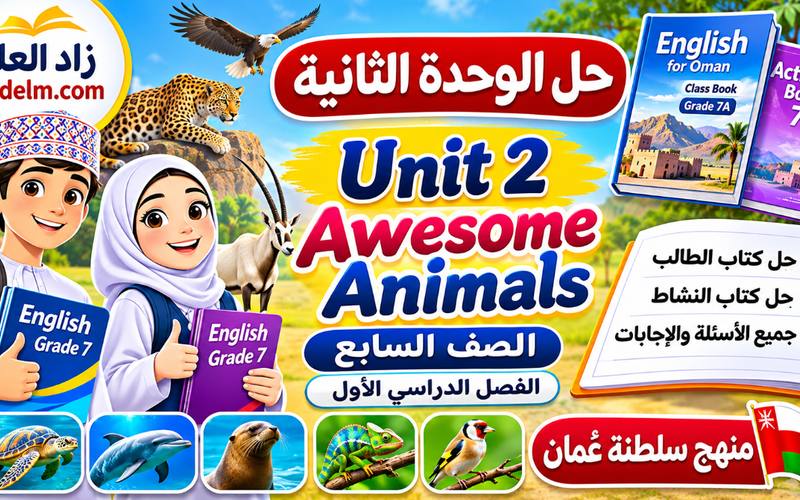
حل الوحدة الثانية Awesome Animals للصف السابع الفصل الدراسي الأول PDF – كتاب الطالب وكتاب النشاط
يقدم لكم موقع زاد العلم zadelm.com كتيب حلول الوحدة الثانية Unit 2 – Awesome Animals في مادة اللغة الإنجليزية للصف السابع الأساسي، الفصل الدراسي الأول، وفق منهج سلطنة عمان، ضمن سلسلة الملفات التعليمية التي تهدف إلى مساعدة الطلبة على فهم الدروس ومراجعة الإجابات والاستعداد للاختبارات.
تحميل حل الوحدة الثانية Awesome Animals
اللغة الإنجليزية – الصف السابع الأساسيملف PDF – 32 صفحة
تحميل الكتيب PDF
عرض الملف قبل التحميل
تم إعداد وتجميع الكتيب وتنزيله منموقع زاد العلم
zadelm.com
يحتوي الكتيب على حلول أسئلة وتدريبات كتاب الطالب (Class Book) وكتاب النشاط (Activity Book) ، مع عرض الإجابات مباشرة على صفحات الكتاب وتوضيحها بألوان مميزة، مما يسهل على الطلبة وأولياء الأمور والمعلمين متابعة الأنشطة والتأكد من صحة الحلول.
محتويات كتيب حل الوحدة الثانية Awesome Animals
تتناول الوحدة الثانية عالم الحيوانات وخصائصها وسلوكياتها، وتساعد الطلبة على اكتساب مفردات جديدة وتطوير مهارات القراءة والاستماع والمحادثة والكتابة باللغة الإنجليزية.
ويشمل الكتيب حلول الدروس والأنشطة التالية:
أولًا: Vocabulary – مفردات الحيوانات
حل تدريبات أسماء أجزاء جسم الحيوان، مثل القرون والمخالب والأجنحة والمناقير والشوارب، بالإضافة إلى تصنيف الحيوانات حسب خصائصها وأشكالها.
ثانيًا: WOW! Team Talk – المحادثة
حل أسئلة الحوارات المتعلقة بوصف الحيوانات والتعرف عليها، مع تدريبات استخدام العبارات المناسبة للتعبير عن الدهشة والتحذير.
ثالثًا: Grammar – القواعد اللغوية
تدريبات استخدام الأفعال المساعدة May, Might, Could, Can’t, Must للتعبير عن الاحتمال والتأكد، مع حلول الأنشطة المتعلقة بوصف الحيوانات والتخمين.
رابعًا: Book Club – نادي القراءة
حل أسئلة قصة The Best Animals on Earth ، التي تتناول اختلاف الحيوانات في خصائصها وقدراتها، مع أنشطة الفهم القرائي وترتيب الأحداث واستخراج المعلومات.
خامسًا: Vocabulary and Grammar
حل تدريبات أفعال الحيوانات وقاعدة الشرط الأولى First Conditional – If + Present Simple, Will + Verb ، مع تطبيقات عملية على المواقف المختلفة.
سادسًا: Culture – الثقافة
حل الأنشطة المتعلقة بالحيوانات الوطنية في دول العالم، مثل المها العربي وطائر الكيوي وتنين كومودو.
سابعًا: English in Action
تدريبات المحادثة والتعبير عن الحيوانات التي نحبها أو لا نحبها، باستخدام عبارات إنجليزية مناسبة.
ثامنًا: Reading and Writing
حل تدريبات قراءة النصوص المعلوماتية عن الحيوانات، وكتابة بطاقات المعلومات (Fact Files)، مع التمييز بين Its وIt’s .
المراجعة والاستعداد للاختبارات
يتضمن الكتيب أيضًا حلول درس المراجعة Review – Lesson 10 ، وأنشطة Get Ready For – Lesson 11 ، التي تساعد الطلبة على التدرب على أنماط الأسئلة في مهارات الاستماع والقراءة والكتابة.
كما يشمل حلول أنشطة القراءات الإضافية:
The Desert Safari The Nature Hunt
وتساعد هذه الأنشطة على تنمية مهارات فهم النصوص واستخراج المعلومات والإجابة عن الأسئلة.
تحميل كتيب حل الوحدة الثانية للصف السابع PDF
يمكن للطلبة تحميل الكتيب بصيغة PDF واستخدامه في المراجعة المنزلية أو أثناء حل الواجبات المدرسية، مع أهمية محاولة الإجابة عن الأسئلة أولًا قبل الاطلاع على الحلول.
معلومات الملف:
المادة: اللغة الإنجليزية.الصف: السابع الأساسي.الفصل الدراسي: الأول.الوحدة: Unit 2 – Awesome Animals.المنهج: سلطنة عمان.المحتوى: حلول كتاب الطالب وكتاب النشاط والمراجعة والقراءات الإضافية.عدد الصفحات: 32 صفحة.صيغة الملف: PDF.
تم إعداد وتجميع هذا الكتيب وتنزيله من موقع زاد العلم – zadelm.com ، الذي يوفر ملفات تعليمية ومراجعات وحلولًا لمختلف الصفوف الدراسية في سلطنة عمان، بهدف دعم التعلم الذاتي وتسهيل وصول الطلبة إلى المصادر التعليمية.
Show all answers Hide all answers Copy visible Q&A
Lesson 1 – Vocabulary (pp. 41–42) Class Book
1. Match: claws, tongue, beak, scales, spines, antennae, paws, flippers, hump, fins, horns, whiskers.
1 claws; 2 whiskers; 3 beak; 4 scales; 5 spines; 6 antennae; 7 paws; 8 flippers; 9 hump; 10 tongue; 11 horns; 12 fins.
2. Which animals are described in the WOW! Quiz?
1 camel; 2 seals; 3 ducks; 4 bees.
3. Which animals have scales?
Alligators.
4. Which animals have a beak?
Birds, such as parrots, eagles and ducks.
5. Which animals have a hump?
Camels.
Lesson 1 – Vocabulary (p. 26) Activity Book
1. Complete the animal body parts (1–12).
1 antennae; 2 beak; 3 claws; 4 fins; 5 flippers; 6 paws; 7 horn; 8 scales; 9 spines; 10 tongue; 11 hump; 12 whiskers.
2. Ants have ___ that they use to communicate.
antennae
3. A rhino has a big ___.
horn
4. Seals use their ___ to move around.
flippers
5. A chameleon catches insects with its ___.
tongue
6. Sea urchins have long ___ for protection.
spines
7. A snake has ___ all over its body.
scales
8. Classify animals by fur, horns, scales and spines.
Fur: bears, rabbits, cats. Horns: Arabian oryx, rhinos. Scales: crocodiles, lizards, sharks. Spines: porcupines.
9. Write sentences about animal body coverings.
Sample: A rabbit has fur. A crocodile has scales. A porcupine has spines.
Lesson 2 – Team Talk (p. 43) Class Book
1. Which animals do they talk about?
Bees, frogs, rabbits, a bear, a bird, a snake and a hedgehog.
2. Why hasn’t Bayan seen any animals yet?
Because she has to look carefully and listen.
3. Why aren’t there any bears there?
Because bears don’t live there.
4. How does Bayan know it’s a hedgehog?
Because it has spines.
5. What does Nawal want to pick up?
The hedgehog.
6. How does Emily think the hedgehog feels?
She thinks it is scared.
7. Complete the expressions for surprise and warning.
Watch out! / Wow! / It’s so cute!
Lesson 2 – Team Talk (p. 27) Activity Book
1. Who says: There are lots of different animals here?
Emily.
2. Who says: Hey! There’s something over there?
Nawal.
3. Who says: It might be a bear with long claws?
Bayan.
4. Who says: It can’t be a bird. It doesn’t have wings?
Nawal.
5. Who says: It doesn’t have scales. Oh! It has spines?
Nawal.
6. Who says: No, you shouldn’t touch it?
Emily.
7. True or false: Emily doesn’t like the place.
False. Emily says that she loves the place.
8. True or false: Bayan has already seen some frogs.
False. She hasn’t seen any animals yet.
9. True or false: There aren’t any bears where the team are.
True.
10. True or false: The animal could be a bird because it has wings.
False. It doesn’t have wings.
11. True or false: Nawal says the animal doesn’t have spines.
False. It has spines.
12. True or false: The team shouldn’t pick up the hedgehog.
True.
13. Complete the six dialogues with expressions.
1 Wow!; 2 It’s so cute!; 3 Watch out!; 4 Watch out!; 5 Wow!; 6 It’s so cute!
Lesson 3 – Grammar (pp. 44–45) Class Book
1. Match the sentences about the animal (1–5).
1 e; 2 d; 3 a; 4 b; 5 c.
2. Which modal do we use when we are sure something is true?
must
3. Which modal do we use when we are sure something is not true?
can’t
4. Which modals show uncertainty?
may, might, could
5. Which bird does the boy see?
C – an eagle.
6. Which is the farmer’s cat?
A.
7. Which toy do they choose?
B – the white toy.
8. Where is the bird the boy can see?
It’s in a tree.
9. Does the bird have a beak?
Yes, it has a yellow beak.
10. What colour are the cat’s paws?
They’re white.
11. Who is the toy for?
The girl’s (Basma’s) new baby cousin.
12. Why can’t the toy have paws?
Because it’s a seal.
Lesson 3 – Grammar (pp. 28–29) Activity Book
1. Match the two parts of the sentences.
1 b; 2 c; 3 a.
2. Listening: choose the correct sentences (1–5).
1 a; 2 b; 3 b; 4 a; 5 b.
3. may / horse
It may be a horse.
4. lion / could
It could be a lion.
5. must / duck
It must be a duck.
6. can’t / rabbit
It can’t be a rabbit.
7. might / eagle
It might be an eagle.
8. may / polar bear
It may be a polar bear.
9. Riddle: It has four short legs, a long tail and scales.
It may be a crocodile.
10. Riddle: It has black and orange stripes.
It must be a tiger.
11. Riddle: A black and white animal with four legs living in Africa.
It can’t be a penguin.
12. Riddle: A very large animal living on land and in water.
It might/could be a hippo.
13. Riddle: A large forest animal with brown fur.
It could/might be a bear.
14. Write three animal riddles.
Sample: It has wings and lives in the jungle. It could be a parrot. / It has a long neck. It might be a giraffe. / It has a hump. It must be a camel.
Lesson 4 – Book Club (pp. 46–47) Class Book
1. Are folk tales new or old stories?
Old stories.
2. Do folk tales teach important things?
Yes.
3. Which animals are in the story?
Lions, fish, birds and a platypus.
4. Which group does the platypus join?
She doesn’t join any group.
5. What lesson does the story teach?
Every animal is special in its own way.
Lesson 4 – Book Club (pp. 30–31) Activity Book
1. Number the sentences about the folk tale (a–g).
a 4; b 2; c 7; d 1; e 6; f 3; g 5.
2. What were the animals fighting about?
They were fighting about who was the best group of animals on Earth.
3. How are the lions and the platypus similar?
They have fur and they are good runners.
4. Why did the fish want the platypus to join them?
The platypus is a good swimmer like them.
5. How is the platypus different from the fish?
She can’t breathe underwater.
6. How are the birds and the platypus similar?
They have beaks and they can lay eggs.
7. What will happen if the platypus joins a group?
The other groups will be unhappy or angry.
8. What does the platypus do at the end?
She doesn’t join any group because everyone is special in their own way.
9. Add -er to the verbs: farm, dive, listen, teach, play, read.
farmer, diver, listener, teacher, player, reader.
10. My uncle lives in the country and has lots of animals. He’s a ___.
farmer
11. I talk to my friend Budo or about my problems. She’s a good ___.
listener
12. I borrow lots of books from the library because I’m a keen ___.
reader
13. Who do you think is the world’s most famous football ___?
player
14. Mrs Amani explains English really well. She’s an excellent ___.
teacher
15. A platypus can swim very quickly. It’s also an excellent ___.
diver
Lesson 5 – Vocabulary and Grammar (pp. 48–49) Class Book
1. Match the animal verbs to pictures (1–12).
1 curl up; 2 bite; 3 sting; 4 dig; 5 die; 6 roar; 7 hide; 8 lay eggs; 9 dive; 10 fight; 11 run away; 12 fly away.
2. Which verbs from Activity 1 appear in the folk tale?
roared, hiding, bite, dive, lay eggs, curled up.
3. Match the first conditional sentences (1–6).
1 b; 2 f; 3 c; 4 e; 5 d; 6 a.
4. What tense follows if in the first conditional?
Present simple.
5. What is used in the result clause?
will + base verb.
6. What can you do to get more animals to come to your garden?
Plant flowers, put out bird food, provide water and tidy up the garden.
Lesson 5 – Vocabulary and Grammar (pp. 32–33) Activity Book
1. Sea turtles ___ holes in the sand.
dig
2. Parrots sometimes ___ .
fight
3. Bees can ___ you.
sting
4. Lions ___ when they are loud.
roar
5. Cats ___ under cars.
hide
6. Whales can ___ more than 2,000 metres underwater.
dive
7. Pill bugs live on land, but only in ___ places.
wet
8. Pill bugs will ___ if they get too dry.
die
9. Pill bugs ___ and carry eggs around.
lay eggs
10. Pill bugs can’t ___ because they don’t have ___.
fly away; wings
11. Pill bugs can ___ from danger and ___ into a ball.
run away; curl up
12. Pill bugs aren’t ___ because they can’t ___ or ___.
dangerous; bite; sting
13. If a lizard loses its tail in a fight, it ___ a new one.
will grow
14. If you ___ nice to me, I will be happy.
are
15. If Shahab feels tired on Saturday, he ___ football.
won’t play
16. If Aliyah ___ her parents for a new dress, they will buy one.
asks
17. If my friends and I go scooting today, we ___ fun.
will have
18. If you ___ your homework, you will fail the exam.
don’t do
19. Complete: If you don’t eat breakfast, …
Sample: I will feel hungry at school.
20. Complete: If you don’t water the plants, …
Sample: They will die.
Lesson 6 – Culture (p. 34) Activity Book
1. What is the national animal of Oman?
Arabian oryx.
2. Which animals use noises and smells to communicate?
Ring-tailed lemurs.
3. Which animal is a very large lizard?
Komodo dragon.
4. Which animal does not drink water?
Arabian oryx.
5. Which animal is the ring-tailed lemur native to?
Madagascar.
6. Which animals use their tongues to locate animals?
Komodo dragons.
7. True or false: A lemur’s tail is easy to see in the forest.
True.
8. True or false: Lemurs are good climbers but aren’t good runners.
False. They are good at climbing and running.
9. True or false: Arabian oryx can find food easily.
False. They must walk long distances to find food.
10. True or false: Arabian oryx don’t live in the wild today.
False. They live in several countries in the wild.
11. True or false: Komodo dragons are very dangerous to other animals.
True.
12. True or false: It’s easy for people to run away from Komodo dragons.
False.
13. Complete the kiwi report (1–10).
1 New Zealand; 2 fly; 3 chicken; 4 feathers; 5 beak; 6 insects; 7 forests; 8 animals; 9 cats; 10 eggs.
Lesson 7 – English in Action (pp. 52, 35) Class Book and Activity Book
1. What animals do the children talk about?
Spiders, ants, sharks and sea animals.
2. What animal is one of the children scared of?
Sharks.
3. Complete: Do you like cats? Yes, ___.
I do! I’m crazy about them!
4. Complete: ___ . I don’t like their fur.
I’m not keen on cats.
5. Complete: Do you like lizards? ___ .
I don’t mind them. And you?
6. Complete: I quite like lizards. ___ .
They’re clean and very quiet.
7. Complete: What animals do you like? ___ .
Well, I find birds very interesting.
8. Complete: What kinds of birds do you like?
All kinds! But my favourites are parrots.
9. Sample: I’m crazy about ___.
birds
10. Sample: I can’t stand ___.
mosquitoes
11. Sample: I don’t mind ___.
cats
Lesson 8 – Literacy: Information Text (pp. 54, 36) Class Book and Activity Book
1. Match the fact files to texts 1 and 2.
1 b (giant prickly stick insect); 2 a (mata mata turtle).
2. Do the information texts have the same information as the fact files?
Yes, they do.
3. Do the information texts have more or less detail?
They have more detail.
4. A ___ is an animal that has a backbone.
vertebrate
5. If something is ___, it is unusual or different.
strange
6. An ___ is an animal that doesn’t have a backbone.
invertebrate
7. A ___ has hard scales all over its body and lays eggs.
reptile
8. An ___ is an invertebrate that has six legs.
insect
9. The mata mata turtle is found in many ___ in South America.
lakes
10. This reptile can ___ up to 15 kilograms.
weigh
11. The giant prickly stick insect lives in the forests of ___.
Australia
12. It has very long ___.
antennae
13. How do you know the mata mata turtle has a backbone?
It is a vertebrate.
14. How do you know it likes water?
It lives in warm lakes, ponds and rivers in South America.
15. What does the mata mata turtle eat?
Fish and other small animals.
16. Why does it need such a long nose?
It uses its very long nose to breathe when hiding in water.
17. Why is the stick insect hard to see?
Its brown or green colour helps it hide on trees.
18. Why are these insects hard to see?
They look like dead leaves or wood.
Lesson 9 – Writing (pp. 55, 37) Class Book and Activity Book
1. What does a hammerhead shark look like?
It has an amazing head that looks like a hammer.
2. Where do hammerhead sharks live?
In warm water in oceans all around the world.
3. How big can a hammerhead shark grow?
Up to 6 metres long and 450 kilograms.
4. What is its favourite food?
Crabs, lobsters, squid, many kinds of fish and stingrays.
5. How does it find stingrays?
It uses its sixth sense to find stingrays hidden in the sand.
6. Does a hammerhead shark lay eggs?
No. It has babies called pups.
7. Does an information text use headings?
No, it doesn’t.
8. Why does an information text use adjectives?
To make the text more interesting.
9. Complete: The mata mata turtle uses ___ long nose to breathe.
its
10. Complete: Ring-tailed lemurs have a long tail. ___ used to fight and communicate.
It’s
11. Complete: A Komodo dragon uses ___ tongue.
its
12. Complete: The Arabian oryx is the national animal of Oman. ___ horns are tall and straight.
Its
13. Complete: A lizard is a type of reptile. ___ in the same family as the crocodile.
It’s
14. Complete: A giraffe eats leaves from tall trees. That’s why ___ neck is so long.
its
Lesson 10 – Review (p. 39) Activity Book
1. Label the animal parts (1–6).
1 beak; 2 whiskers; 3 horn; 4 paws; 5 fins; 6 hump.
2. Lions make a lot of noise when they ___.
roar
3. Cats often ___ under cars.
hide
4. You and I argue, but we don’t ___.
fight
5. Rabbits often ___ holes in gardens.
dig
6. Some insects can ___ you.
sting
7. If a bird is scared, it will ___.
fly away
8. It’s long and it doesn’t have legs.
It may be a snake.
9. It’s very big and grey. It has big ears.
It might be an elephant.
10. It has long legs, a tail and lots of hair.
It could be a giraffe.
11. It has two legs and it lays eggs.
It can’t be a mouse.
12. It’s black and white and it looks like a horse.
It must be a zebra.
13. If I pass my English exam, …
I will be very happy.
14. If you call me after 11 o’clock at night, …
Sample: I won’t answer the phone.
15. If the football team wins, …
Sample: We will celebrate.
16. If students don’t do their homework, …
Sample: They will have problems in class.
17. If you stay up really late tonight, …
Sample: You will be tired tomorrow.
Lesson 11 – Get Ready For (pp. 57, 40–41) Class Book and Activity Book
1. How long has Thuriya been a writer?
B – For twenty years.
2. Thousands of children ___ .
C – read the magazine.
3. How often does Thuriya cook dinner?
A – Twice a week.
4. Thuriya travelled to Antarctica ___ .
C – three weeks ago.
5. Thuriya thinks ___ .
B – Antarctica is too cold.
6. Which animal will Adil write about?
B – tiger.
7. Listening: match Ruba, Samira, Manar, Basma and Reem.
1 Ruba – H (platypus); 2 Samira – A (jellyfish); 3 Manar – C (camel); 4 Basma – F (dolphin); 5 Reem – G (lemur).
8. Look at how fast that cat is eating! It ___ be very hungry.
must
9. I’m sorry, but I ___ talk now.
can’t
10. Please be quiet. If you’re noisy, the birds ___ fly away.
will
11. Email gap 0: I ___ a great time at the zoo.
had
12. Email gap 1: There were so many cool animals to ___.
see
13. Email gap 2: I saw ___ of amazing birds.
lots
14. Email gap 3: There was an eagle ___ had enormous wings.
that / which
15. Email gap 4: Animals ___ camels and lizards.
like
16. Email gap 5: A big lizard ___ green scales.
with
17. Email gap 6: If we ___ back there, …
go
Graded Reader 1 – The Desert Safari (p. 108) Graded Reader
1. Match the pictures: sand dune, scorpion, truck.
1 b; 2 c; 3 a.
2. What happens in the story?
The boys go on a desert safari and see animals.
3. Which animals does Khalid see?
Scorpion, lion, eagle, gazelles, lizards and leopard.
4. The eagle has a large beak and sharp ___.
claws
5. Gazelles use their long horns to ___ each other.
fight with
6. The guide throws some ___ to the leopard.
meat
7. Match: The eagle is looking for …
c – some food to eat.
8. Match: Scorpions are dangerous …
a – because they can sting.
9. Match: Not many people see …
b – an Arabian leopard.
Graded Reader 2 – The Nature Hunt (p. 109) Graded Reader
1. Match: prize, nature hunt, beetle.
1 c; 2 a; 3 b.
2. What happens in the story?
The girls try to find all the animals to win the nature hunt.
3. Which animals do Sabah and Noora see?
Fish, flamingos, a frog, a hedgehog and a beetle.
4. They are doing a nature hunt with their ___.
class
5. The girls see a hedgehog ___.
in the trees
6. The last animal they see is the one with ___.
antennae
7. Match: The small grey fish …
b – have fins and scales.
8. Match: The flamingos …
c – lay eggs.
9. Match: The hedgehog …
a – has spines.

اترك تعليقاً