ملخص Unit 3: The Future of Transport الوحدة الثالثة: مستقبل النقل لمادة اللغة الانجليزية للصف العاشر الفصل الدراسي الثاني المنهج العماني

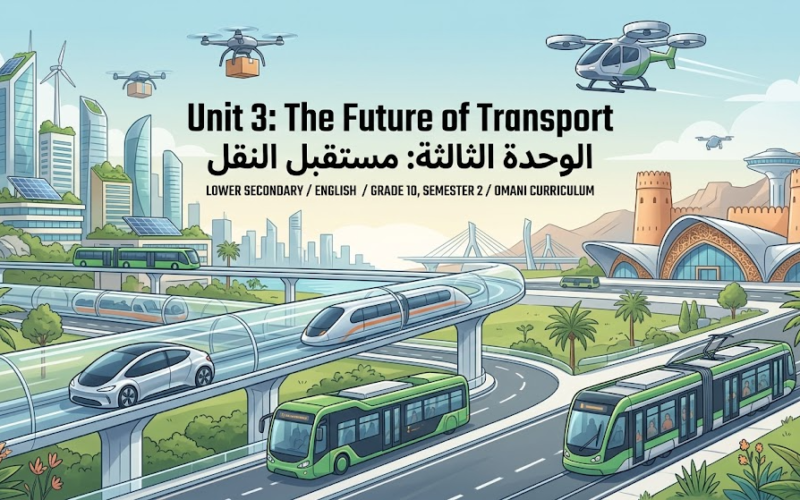
ملخص Unit 3: The Future of Transport الوحدة الثالثة: مستقبل النقل لمادة اللغة الانجليزية للصف العاشر الفصل الدراسي الثاني المنهج العماني
نقدم لكم ملخص Unit 3: The Future of Transport الوحدة الثالثة: مستقبل النقل لمادة اللغة الانجليزية للصف العاشر الفصل الدراسي الثاني المنهج العماني
Overview / نظرة عامة
This unit explores futuristic transportation technologies, including self-driving cars, hyperloops, flying cars, and jetpacks. Students learn to discuss advantages and disadvantages, make predictions, and write opinion essays.
تستكشف هذه الوحدة تقنيات النقل المستقبلية بما فيها السيارات ذاتية القيادة والهايبرلوب والسيارات الطائرة والجت باك. يتعلم الطلاب مناقشة المزايا والعيوب وعمل تنبؤات وكتابة مقالات رأي.
Key Vocabulary / المفردات الأساسية
- Transport (النقل) — The means by which people or goods move from one place to another.
- Automated (آلي/أوتوماتيكي) — Working without human control. “Most means of transport will be automated.”
- Self-driving (ذاتية القيادة) — A vehicle that drives itself without a human driver.
- Hyperloop (الهايبرلوب) — A high-speed ground transport system using magnetic levitation in low-pressure tubes.
- Hovercraft (مركبة التحليق) — A vehicle that moves on a cushion of air above a surface.
- Efficient (فعّال) — Working well with minimum waste of time or resources.
- Non-stop (بدون توقف) — Without any stops.
- Autonomous (مستقل/ذاتي) — Able to operate independently.
- Levitation (التحليق المغناطيسي) — The process of floating in the air using magnetic force.
- Friction (الاحتكاك) — The resistance when surfaces rub against each other.
- Licence (رخصة) — An official document giving permission to do something.
- Destinations (الوجهات) — Places where someone is going.
- Speed (السرعة) — How fast something moves.
- Vehicles (المركبات) — Machines used for transportation.
- Congestion (الازدحام) — When roads are very busy with traffic.
Reading Texts: Future Transportation / نصوص قرائية: وسائل النقل المستقبلية
1. Hyperloop / الهايبرلوب
Passengers travel in floating pods inside giant low-pressure tubes. Pods use magnetic levitation to reduce friction — no wheels needed. Suggested speed: 1,080 km/h, which is 4-5 times faster than a normal train. Could make travel faster, safer, and more environmentally friendly.
يسافر الركاب في كبسولات عائمة داخل أنابيب ضخمة منخفضة الضغط. تستخدم الكبسولات الرفع المغناطيسي لتقليل الاحتكاك. السرعة المقترحة 1,080 كم/ساعة، أي 4-5 أضعاف سرعة القطار العادي.
2. Self-Driving Vehicle / المركبة ذاتية القيادة
An autonomous vehicle using lasers, radars, and high-powered cameras to create an internal map and guide itself. It will significantly reduce road traffic accidents. “This kind of transport is just around the corner.” — هذا النوع من النقل على وشك الوصول.
مركبة مستقلة تستخدم الليزر والرادار وكاميرات عالية الأداء لإنشاء خريطة داخلية وتوجيه نفسها. ستقلل بشكل كبير من حوادث الطريق.
3. Jetpack / الجت باك
A transportation device worn over the shoulder with two fans powered by an engine. It can fly for up to 30 minutes at a maximum speed of 74 km/h. Users need a pilot’s licence. Pilots wear a heat-resistant flying suit, helmet, and boots. Best suited for firefighters or emergency rescue teams. Includes a low-tech plastic parachute for safety.
جهاز نقل يُلبس على الكتف بمروحتين تعملان بمحرك. يطير لمدة 30 دقيقة بسرعة 74 كم/ساعة. يحتاج المستخدمون إلى رخصة طيار. الأنسب لفرق الإنقاذ.
4. Flying Car / السيارة الطائرة
Can be flown in the sky or driven on roads. Has features of both a plane (airscrew) and a car (tyres). Light enough to fly, strong enough to drive. Fully automated — driver enters the destination’s phone number or address. Needs less parking space than a plane, more convenient than a car. “It has the best of both worlds.” — تجمع أفضل ما في العالمين.
يمكن تحليقها في السماء أو قيادتها على الطرق. تجمع مميزات الطائرة والسيارة. آلية بالكامل — المشغل يدخل العنوان وتفعل الباقي.
Grammar / القواعد النحوية
Predicting the Future / التنبؤ بالمستقبل
1. Going to / سيكون — للتنبؤ المبني على دليل: Used when there is evidence for the prediction. يُستخدم حين يوجد دليل على التنبؤ.
- “You are going to miss the plane unless you hurry up.” — ستفوتك الطائرة ما لم تسرع.
- “Space is going to become a popular tourist destination.” — الفضاء سيصبح وجهة سياحية شهيرة.
2. Will / سيـ — للتنبؤ المبني على رأي: Used for opinions about the future. يُستخدم لإبداء الرأي حول المستقبل.
- “Cars will shortly be able to communicate with each other.” — ستتمكن السيارات قريبًا من التواصل مع بعضها.
- “In the future, people will be expected to drive electric vehicles.” — في المستقبل، من المتوقع أن يقود الناس سيارات كهربائية.
3. Modal Verbs of Possibility / أفعال الإمكانية المساعدة:
- May (not) — يجوز/يُحتمل (حيادي): “Cars may soon become autonomous.” — قد تصبح السيارات مستقلة قريبًا.
- Might (not) — ربما (أقل تأكيدًا): “Within 10 years, flying cars might become a reality.” — قد تصبح السيارات الطائرة واقعًا خلال 10 سنوات.
- Could (not) — يمكن أن: “A passenger could travel between two cities in a few minutes.” — يمكن للراكب السفر بين مدينتين في دقائق.
Degrees of certainty (from most to least certain):
- Will → Going to → May → Might → Could درجات اليقين (من الأكثر إلى الأقل): Will ← Going to ← May ← Might ← Could
Idioms / التعابير الاصطلاحية
Idioms are words or phrases with a different meaning from their individual words. التعابير الاصطلاحية هي كلمات أو عبارات تعني شيئًا مختلفًا عن معنى كلماتها المفردة.
- “Let the cat out of the bag” — to accidentally reveal a secret. كشف سر بالخطأ. “Your brother let the cat out of the bag.” — أفشى أخوك السر.
- “Keep your fingers crossed” — to hope for good luck. أتمنى لك الحظ الجيد. “Keep your fingers crossed for me.” — ادعُ لي بالحظ.
- “Just around the corner” — coming very soon. قريب جدًا. “This kind of transport is just around the corner.” — هذا النوع من النقل على وشك الوصول.
- “The best of both worlds” — enjoying advantages of two different things. الاستفادة من أفضل ما في الأمرين. “It has the best of both worlds.”
- “I miss the boat” — I missed a chance/opportunity. فوّت الفرصة.
- “A piece of cake” — something very easy. سهل جدًا.
Writing: Opinion Essay (Advantages and Disadvantages) / الكتابة: مقالة الرأي (المزايا والعيوب)
Structure / البنية:
📱 تابعنا على واتساب: اضغط هنا
- Introduction (المقدمة): General remarks about the topic WITHOUT giving your opinion. “Have you ever daydreamed about flying your car over the road? The idea seems mind-blowing, but these cars may soon be filling our skies.”
- Advantages Paragraph (فقرة المزايا):
- “To begin with, flying cars can be time-saving…”
- “Moreover, flying cars are easy to use because they have an automated system.”
- Disadvantages Paragraph (فقرة العيوب):
- “On the other hand, flying cars do have some disadvantages. First, flying cars will be expensive…”
- “Secondly, flying cars might be more dangerous…”
- Conclusion (الخاتمة): Summary of both views + your opinion. “In conclusion, I believe that flying cars will be used in the near future, because they have so many advantages. However, I am still not convinced about how safe they really are.”
Linking Words / كلمات الربط:
- To add: Furthermore, Moreover, In addition, Also — علاوة على ذلك، بالإضافة إلى ذلك.
- To contrast: On the other hand, However, But — من ناحية أخرى، ومع ذلك.
- To sequence: First, Secondly, Finally, To begin with — أولاً، ثانيًا، أخيرًا، للبدء.
- To conclude: In conclusion, Therefore, As a result — في الختام، لذلك، نتيجة لذلك.
اترك تعليقاً